


What Is Nail Treatment? Types, Benefits and When You Need One
Healthy nails are not a style statement. In humid, coastal areas like Kollam, nails can also be a “health indicator” because of fungal infections, repeated wet work, and tight footwear which quickly show up as thick, brittle, discolored, or painful nails. This is why timely nail treatment in Kerala is becoming increasingly important for both health and cosmetic reasons.
Have you ever searched for the right nail treatment because your nail color or shape suddenly changed? You no longer need to cover it up with fancy nail polish, TLC Skyn has the expertise to diagnose and treat the nail condition.
What Is Nail Treatment?
In simple words, it is any professional or medically guided care that improves the health, strength, appearance, or comfort of your nails.
Nail treatment can be for the following reasons:
- Cosmetic (improving look and smoothness): cuticle care, strengthening, safe buffing, treating dryness.
- Medical (treating disease): fungal nail infection (onychomycosis), ingrown nails, bacterial infection around the nail, nail psoriasis, trauma-related nail lifting, and suspicious dark streaks.
A key trend in 2025 and 2026 is that more people are doing long-wear manicures (gel, acrylic, press-ons). Dermatologists are also seeing more nail issues linked to these habits, such as brittlenails, peeling, allergic reactions to nail products, and infections hidden under extensions.
Why nail problems are common in Kollam’s climate
Kollam’s warm and humid weather can create the perfect environment for fungus to grow, especially if you:
- Wear closed shoes for long hours
- Sweat a lot (hyperhidrosis)
- Frequently get your hands wet (cleaning, childcare, hospitality work)
- Share nail clippers at home or in salons
A widely cited clinical point is that fungal nail infection is one of the most common nail disorders. An American Family Physician review notes that onychomycosis is responsible for about 50% of nail abnormalities and is more common with age and certain health conditions like diabetes. You can read the overview here: American Family Physician (onychomycosis review).
Quick prevalence snapshot
The American Academy of Dermatology also highlights that nail fungus becomes more common with age. Here is a simple way to visualize the risk trend:
| Group | Often-cited prevalence | What this means for you |
| General population | ~10% | 1 in 10 people may have nail fungus at some point |
| Age 60+ | ~20% | Risk roughly doubles with age |
| Age 70+ | ~50% | Every second person may be affected |
Types of nail treatment
Most people looking for Nail Treatment in Kollam fall into one of these three buckets.
Cosmetic nail care (best for dryness, roughness, dullness)
This includes safe trimming, shaping, cuticle care, and strengthening. It can help if your nails are:
- Dry and splitting
- Weak from frequent sanitizer use
- Rough after removing gel polish
Strategic advice: If you are doing gel or acrylic frequently, take “recovery breaks” and prioritize nail hydration. The AAD shares practical tips to reduce damage from gel manicures, including gentle removal and protective steps: AAD tips for healthy nails.
Salon-based services (best for cosmetic reasons)
Salon services give instant results though temporary, however underlying cause remains hidden. If a nail looks infected, thick, greenish, painful, or smelly, covering it can delay proper care.
Strategic advice for Kollam: Choose salons that sterilize tools properly and avoid “aggressive scraping” under the nail, which can worsen infections.
Medical nail treatment (to know the real pathology)
This is where a dermatologist becomes important. Once the cause of nail infection is diagnosed, evidence based medical treatment and its surgical solution can be suggested.
The salons tend to miss the nail disease and focus on the nail apperance alone but a dermatologist can diagnose nail disease and rule out serious causes.
Common nail concerns and the right treatment approach
This table can help you quickly match the symptom to the next step.
| What you notice | Common cause | What a clinician may do |
| Yellow, thick, crumbly nail | Fungal infection | Nail sample test, topical or oral antifungal, sometimes device-based options |
| Painful edge digging into skin | Ingrown nail | Soaking guidance, antibiotic if infected, partial nail removal in recurring cases |
| Green discoloration | Bacterial colonization (often Pseudomonas) | Drying protocol, topical antibiotics, reduce occlusion (tight shoes, extensions) |
| Pitting, “oil spots,” lifting | Nail psoriasis | Anti-inflammatory treatments, sometimes injections or systemic care depending on severity |
| Dark line that is new or changing | Needs urgent evaluation | Dermoscopy and medical assessment to rule out serious causes |
Treatment comparison: what actually works for fungal nails?
Fungal nail infection is the most common reason people seek medical nail care. The challenge is that nails grow slowly, so even effective treatment takes time.
Here is a practical comparison based on clinical guidance and published outcomes.
| Option | Best for | Typical pros | Typical limitations |
| Prescription topical antifungal | Mild to moderate cases, thin nails, early disease | Low systemic risk, easy to apply | Requires daily consistency for months, lower complete cure rates than oral therapy in many studies |
| Oral antifungal medication (prescribed) | Moderate to severe cases, multiple nails, thick nails | Higher effectiveness in many studies | Not suitable for everyone, may require medical review and monitoring |
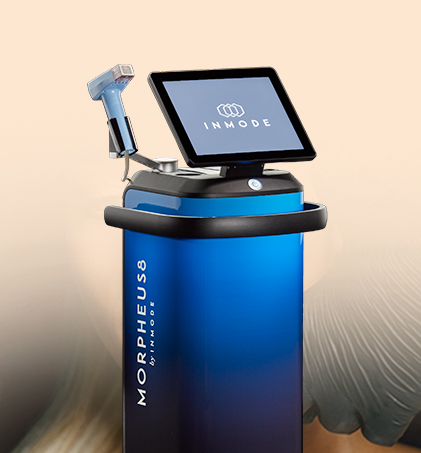
| Device-based options (laser and similar) | Selected cases or combination plans | Minimal downtime, can be paired with topicals | Results vary, often works best as part of a combination plan |
| Combination approach | Many real-world cases | Targets fungus from multiple angles | Requires planning, patience, and follow-up |
If you want a “numbers-based” expectation: clinical reviews often show oral terbinafine has higher mycologic cure rates than many topical-only options, while some topical therapies have complete cure rates in the teens in trials. Your dermatologist should confirm diagnosis first, because psoriasis and trauma can look similar to fungus.
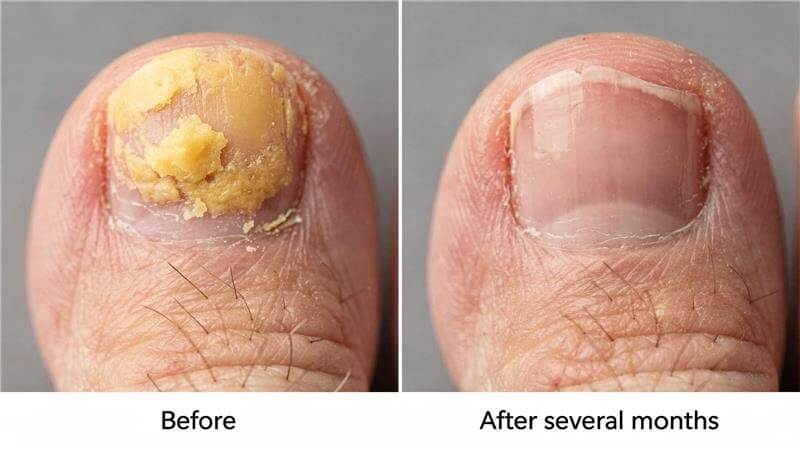
Before and after: what “real” results look like (and when)
Many clinic pages show instant transformations, but nail treatment is different. The real before-after change is tied to nail growth.
Here is a realistic timeline for a fungal toenail improvement (example pattern, results vary by person and severity):
| Timepoint | What you may see in the nail | Best action |
| 2 to 4 weeks | Less spreading, reduced discomfort, nail may still look the same | Stay consistent, do not stop early |
| 8 to 12 weeks | Healthier nail growth visible near the cuticle | Continue plan, treat shoes and socks hygiene |
| 6 to 12 months | Old damaged nail gradually replaced by clearer nail | Maintenance, prevent reinfection |
Key takeaway: A “good before-after” is usually a clearer new nail growing in from the base, not a quick surface whitening.
When you should get a nail treatment (do not wait)
Consider medical evaluation if you have any of the following:
- Nail pain, swelling, pus, or warmth around the nail
- Nail lifting that keeps spreading
- Sudden color change (especially dark brown or black streaks)
- Repeated ingrown nails
- Thickened yellow nails that do not improve with basic care
- Diabetes, poor circulation, or low immunity (do not self-treat for long)
For people actively searching best dermatologist kollam, a useful strategy is to ask the clinic one specific question before booking: Do you confirm nail fungus with a test, or do you treat based on appearance only? Testing helps avoid wasted months on the wrong plan.
2026 trends and smarter strategies
Trend 1: “Bare nail” and minimalist manicures for nail recovery
More people are taking breaks from gel and acrylic to rebuild nail strength. The strategy is not just stopping polish, but adding structure:
- Gentle hydration (cuticle oil, barrier creams)
- Avoiding aggressive buffing
- Using gloves for wet work
Trend 2: Combination plans for stubborn problems
For stubborn fungal nails or recurring ingrowns, a multi-step plan often works better than a single solution. This includes treating nails plus the environment (shoes, socks, shower floors).
Trend 3: Dermatology-led aesthetic clinics expanding beyond “skin only”
Premium clinics increasingly take a full approach to appearance and wellness. The operational base of TLC Skyn exists in Kerala yet its dermatologist leadership system represents the forthcoming development of the field through its method of assessing individuals while using safe technologies to predict actual results.
Frequently Asked Questions
What Is Nail Treatment and is it only for nail fungus?
Includes both cosmetic nail care (strengthening, hydration, safe shaping) and medical care (fungal infection, ingrown nails, nail psoriasis, infections around the nail, and more). It is not only for fungus.
How do I know if my nail problem is fungal or just damage from gel polish?
Fungal nails often become thick, crumbly, and yellow, and may spread to other nails. Gel damage more often looks like peeling layers and surface roughness. A proper test at a clinic can confirm fungus.
How long does it take to see before-after results for toenail fungus?
Most people need months, not weeks. Toenails grow slowly, so visible clearing usually appears as healthy growth from the base over 6 to 12 months, depending on severity and treatment choice.
Is it safe to get a salon pedicure if I suspect infection?
It is better to pause salon services until you get a diagnosis. Covering an infection can worsen it and may spread it to tools or other nails.
When should I see a dermatologist urgently for a nail issue?
If you have pain, pus, spreading swelling, a dark streak that is new or changing, or if you have diabetes or low immunity, do not delay medical evaluation.
Ready to fix the root cause, not just cover the nail?
If your nail issue keeps returning, the best next step is a proper diagnosis and a plan you can actually follow. If you are in Kollam or traveling and want dermatologist-led care, you can explore TLC Skyn and book a consultation in TLC Skyn. For those in Kerala, use the same standard when choosing a local clinic: confirm the cause first, then choose the treatment that fits your nail condition and lifestyle.